Advisory & Strategy
Sep 22, 2026
Your Team Isn't Resisting AI. It's Out of Capacity
AI adoption in finance is not failing because people do not want it. It is failing because teams have no capacity left for another change.

Most finance and accounting teams are not starting their AI journey from a blank slate. They are starting it after years of new systems, evolving reporting standards, restructures, ownership changes, and process redesigns. They are tired. And while AI is described using sweeping terms such as ‘revolutionary,’ that description does not help someone understand where to begin on Monday morning. Without a practical use case and a clear first step, AI can feel like one more vague initiative teams are expected to absorb.
The fatigue was already here
The data on this is not subtle. A July 2024 Gartner survey of 473 HR leaders found that 73 percent said their employees are fatigued from change, and 74 percent said their managers are not equipped to lead change. That is not a finance-specific number, but it sets the baseline: most organizations, across most functions, are already struggling with the volume of change moving through them.
The trend line underneath that number is the real story. Gartner data shows employees' willingness to support enterprise change falling sharply in just six years:
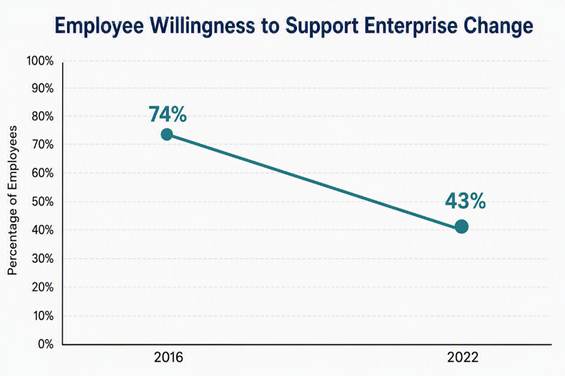
In 2016, 74% of employees were willing to support enterprise change. By 2022, that figure had fallen to 43%.
Over that same stretch, the volume of change people were asked to absorb went the opposite direction:

In 2016, employees experienced an average of two planned enterprise changes. By 2022, that number had risen to ten.
Read those two tables together and the pattern is hard to miss. People are not being asked to handle a little more change than before. They are being asked to handle several times more, with far less appetite for it than they had six years earlier.
Where AI lands in all of this
Now add AI on top, not as a standalone initiative with its own timeline and its own change plan, but as the newest arrival into a queue that was already full.
For a team with little change capacity left, AI can feel less like an opportunity and more like another demand. Employees are being asked to learn unfamiliar tools, rethink established processes, judge new risks, and still meet the same close, reporting, control, and audit deadlines. Some are even given mandates to “figure it out” and “find $X worth of savings” with little direction as to how and when. Even people who are curious about AI may delay using it when experimentation creates more work before it removes any.
That is how fatigue becomes adoption resistance. When AI creates work before it removes work, people protect the routines that help them deliver reliably. They avoid changes that could introduce errors and wait for clearer guidance or proof of value before taking on more risk. That hesitation is not necessarily a rejection of AI. It is often a practical response to limited time, low trust, and no visible capacity for the learning curve.
The real problem is capacity, not adoption
In finance and accounting, that overload has a practical shape. The close still has to finish, reports still have to go out, controls still have to operate, and audit requests still have to be answered. If AI is introduced without removing work, clarifying priorities, or showing where it fits, employees are effectively being asked to experiment with a revolutionary technology on top of a full workload. Under those conditions, staying with the current process can feel less like resistance and more like responsible risk management.
The broader data points in the same direction. In a 2025 Gartner survey, 79 percent of employees reported low trust in change. Separate Gartner research found that only 32 percent of business leaders said their organizations were achieving healthy change adoption. AI is entering organizations where trust is already low and successful change is already uncommon.
This apparent conflict is the premise for the rest of this series: AI adoption in finance and accounting is not primarily a technology or training problem, it is a capacity problem. If leaders want teams to experiment, they must create room for the learning curve, clarify where AI fits, and show what work it will eventually remove. Otherwise, resistance is a predictable response to overload.
What comes next
In the next post, I will examine what leaders can do before introducing AI to their teams: build the right coalition, define a credible business case, and balance pressure for fast returns with the groundwork successful change requires.
Where are you seeing this show up in finance teams? Is the hesitation about AI itself, or is it a sign that the team has no capacity left for another change?
Sources: Gartner research on employee change fatigue, workforce willingness to support change, and healthy change adoption, published between 2024 and 2025.
Search Articles
SUBMIT Search